 Naxos Boat Tours
The Best Time to Sail in Naxos: Months, Wind and the Meltemi
The best time to sail in Naxos has a shape, and the shape is wind: the same ticket books a glass-water idyll in June and a lively deck ride in late July, without the operator changing anything. This guide maps the season - the meltemi's months, the sea's warmth, the hours that matter inside any day - and matches each window to the boats in the Naxos boat tours comparison.
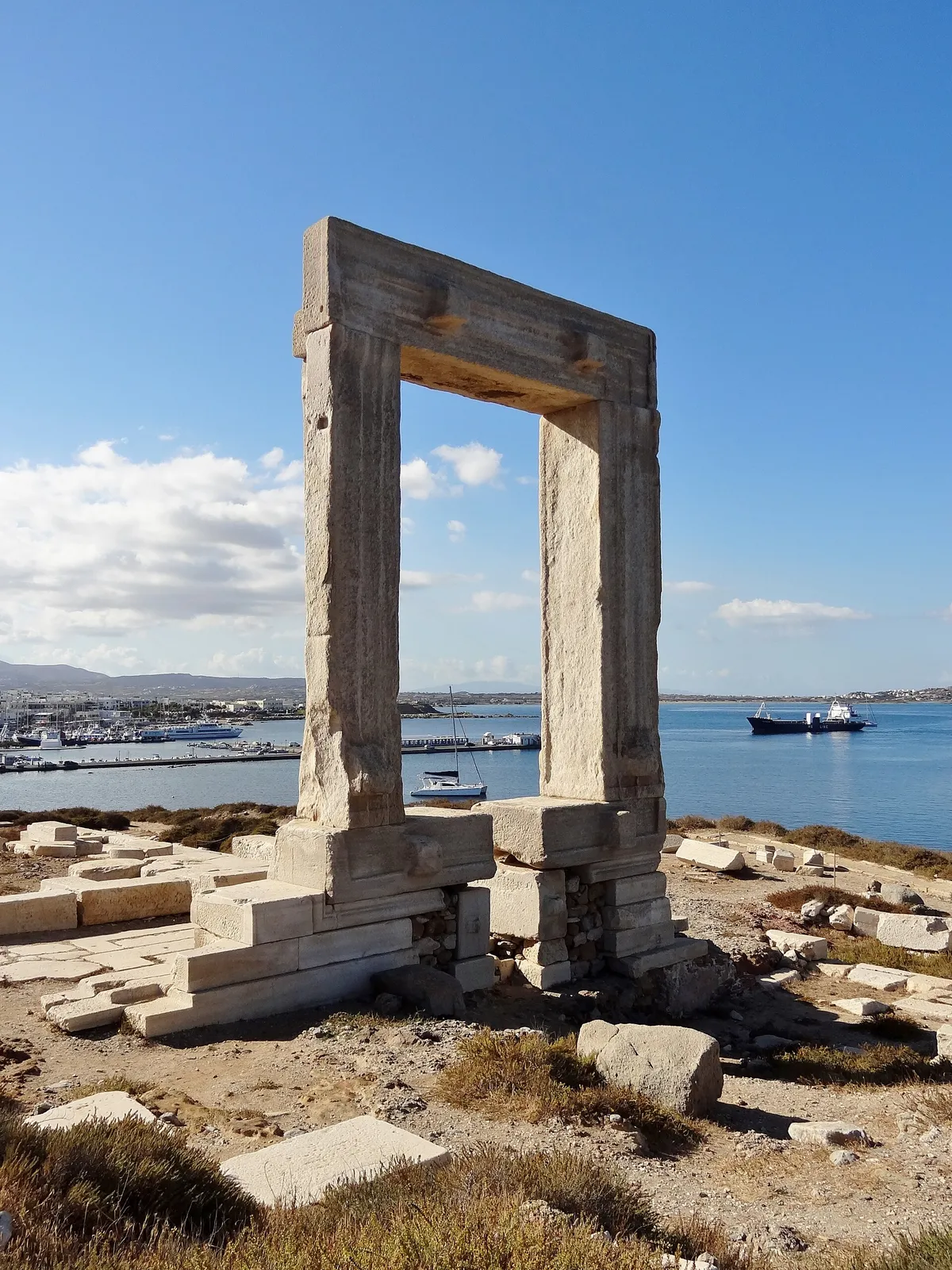
The Portara over the harbour - the season's constant while the wind changes everything else. Photo: Wikimedia Commons (CC BY), attribution in caption.
Quick answer Two prime windows, one wind system, one rule about mornings - the season in four sentences
The best time for a Naxos boat trip is May-June (warm water, sleepy wind, everything running) or September-October (the warmest sea of the year after the summer's heating, softening wind, thinner decks). July-August run the fullest schedules against the meltemi at its peak - perfectly bookable, but choose morning departures and hold a buffer day. Within any day, the rule barely changes by month: mornings ride flattest, because the northerly builds from late morning on. Every Naxos boat trip compared here cancels free up to 24 hours - the season's real tool.
Key takeaways
- First choice: late May-June - the season's calm-water window at pre-peak prices.
- Warmest water: September, sea at its yearly maximum (~24-25°C) with wind already easing.
- Peak-week pattern: book mornings, book early-week, keep one spare afternoon for the meltemi's opinion.
The Meltemi, Explained for Boat Bookers
The meltemi (ετησίαι to the charts, "the wind" to the island) is the Aegean's summer engine: a dry northerly that settles over the islands from roughly mid-June, blows hardest through July and August, and hands the season back through a September that can still gust. Four facts do all the booking work:
It is northerly and predictable in direction even when its strength is not - which is why Naxos's west coast (facing the wind) is the wave side, and the south-coast coves and the Small Cyclades' leeward harbours are the calm answers.
It builds through the day. Nights are calm, mornings gentle, late afternoons the liveliest water a ticket can buy. Every 8:30 check-in in the Naxos day boats compared here is this fact with a timetable.
It peaks in force, not in presence. July-August bring the strongest spells - Force 5-7 days that rearrange routes - while June and September blow softer more often.
It announces itself. Unlike storm systems, the meltemi shows on every forecast two-three days out; the free-cancellation window on every listing in the comparison exists precisely so a booker can treat a forecast as an itinerary.
The satellite view below is what the meltemi looks like from above: wind streaks striping the Aegean on a July day - and the reason the island's boats keep flexible route cards.
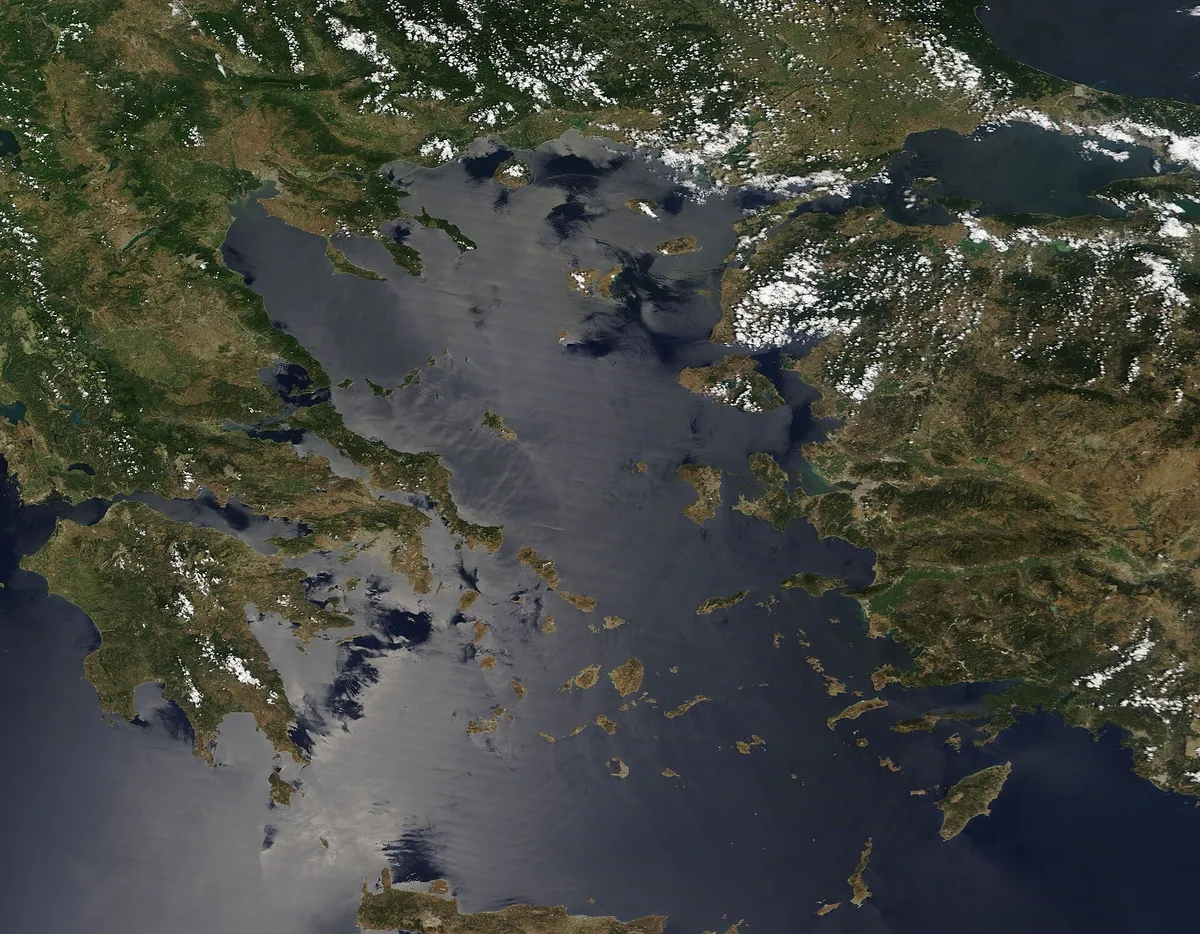
The meltemi from orbit: wind streaks striping the Aegean in mid-July (MODIS). The direction is steady northerly - the strength is the only surprise. Photo: NASA/Wikimedia Commons (public domain).
Month by Month on the Water
Average daytime highs for Naxos town, with the boating verdict that actually changes a booking (sea temperatures lag the air by a few weeks - September swims warmer than June):
| Months | Air (avg high) | What the month is actually like | Boating verdict |
|---|---|---|---|
| Apr | 19°C / 66°F | Season opens mid-month-ish; everything runs but some boats on reduced schedules; water fresh | Good with a flexible booking |
| May | 23°C / 73°F | Prime: gentle wind, empty-ish decks, islands at their floweriest | Best overall window |
| Jun | 28°C / 82°F | Prime continuing; meltemi waking mid-month but mostly kind | Best overall window |
| Jul | 30°C / 86°F | Meltemi peaks; fullest boats; morning slots gold, swim stops shelve on strong days | Book early, book mornings |
| Aug | 30°C / 86°F | Meltemi at full force; decks full; the sea warmest it has been all year | Book early, book mornings |
| Sep | 26°C / 79°F | Wind easing, sea at yearly max, crowds thinning - the connoisseur's month | Excellent |
| Oct | 22°C / 72°F | Season's tail: calm weeks between blows; some boats shorten runs late-month | Good early-month |
| Nov-Mar | 14-18°C / 57-64°F | The fleet mostly lays up; island becomes a land holiday | Off - plan land days |
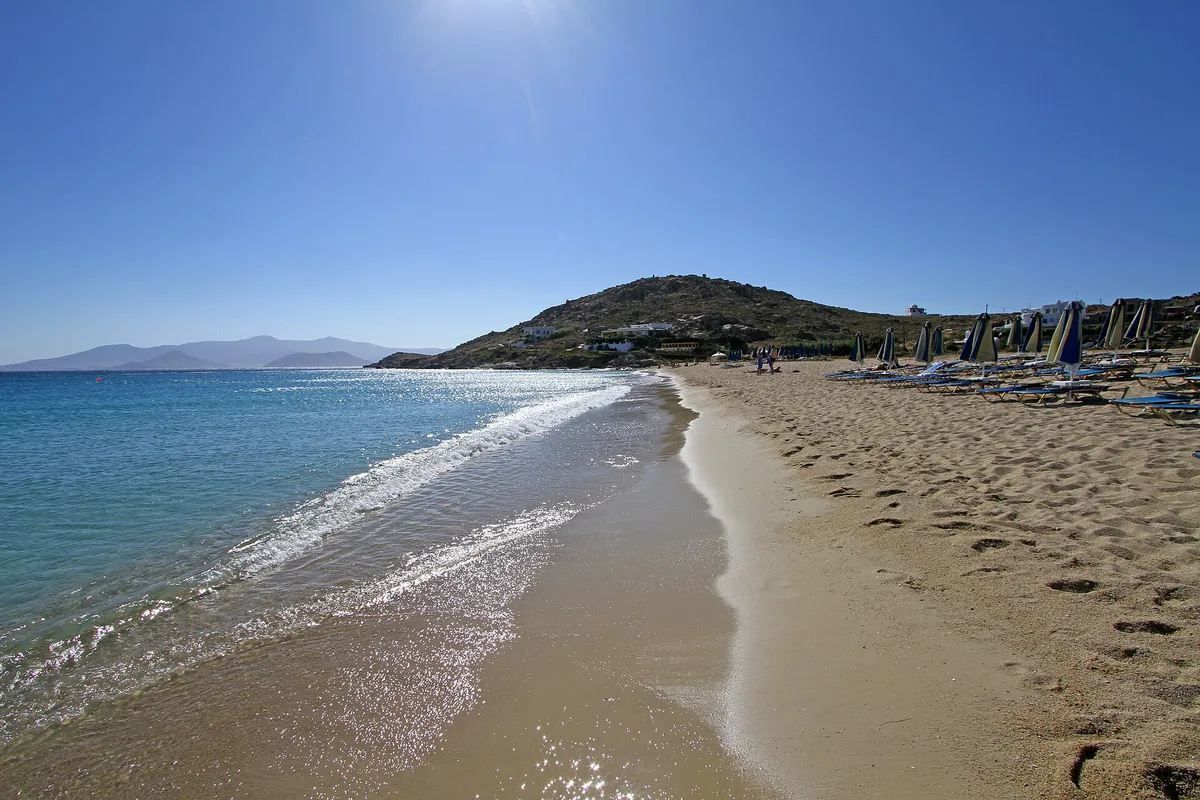
June light on Agios Prokopios - the calm-water month the west coast was named for. Photo: Wikimedia Commons (CC BY-SA), attribution in caption.
Mornings vs Afternoons: The Wind Does the Deciding
Inside any month, the day has a shape and it is the same shape:
Dawn to noon: the flat hours. The overnight calm lingers; the meltemi is a breeze, not a regime. This is when the flagship checks in at 8:30, when the Panermos cave water is clearest, and when sea-sickness-prone travellers forget they brought tablets.
Noon to three: the build. The northerly finds its voice; whitecaps appear on the exposed legs. Boats are typically at anchor for lunch - the smart schedule puts the choppiest water under the meal, not the swim.
Three to six: the ride home. The return legs of the full-day boats run the day's liveliest water. It is fun-for-most, queasy-for-some: sit aft, take the tablet before boarding, and let the crew's line do its work.
The evening exception: sunset sails run against the build's tail but in protected water close to the quay - the 2.5-hour champagne trip picks its anchorage for exactly this. Short exposure, sheltered sea: the evening slot is calmer than its hour suggests.
The summary rule: whatever the month, the earliest departure holds the flattest water - and the second-best slot is whatever the captain calls sheltered.
Shoulder Season: April, Late October, November
The shoulders are where the island's veterans book, and where expectations need calibrating:
April opens the season mid-month in most years: the full fleet back, water clear and cool (a short swim in a wetsuit-optional sea), islands green - the one month the Cyclades look like Ireland with better light. Book with flexibility: reduced schedules mean fewer re-booking slots if a day cancels.
Early-mid October runs a genuine second season: sea at its warmest carryover, wind in its autumn on-again-off-again pattern, and boats running full routes with empty back rows. Late October shortens days and schedules together - confirm departure times the week you travel.
November is the season's door clicking shut: the compared fleet starts laying up, ferries thin, and the boat day becomes a schedule-dependent treat rather than a plan.
The booking-tool note for shoulders: the pay-later hold earns its keep here - schedules and weather both move weekly, and the free-cancellation window absorbs the movement.
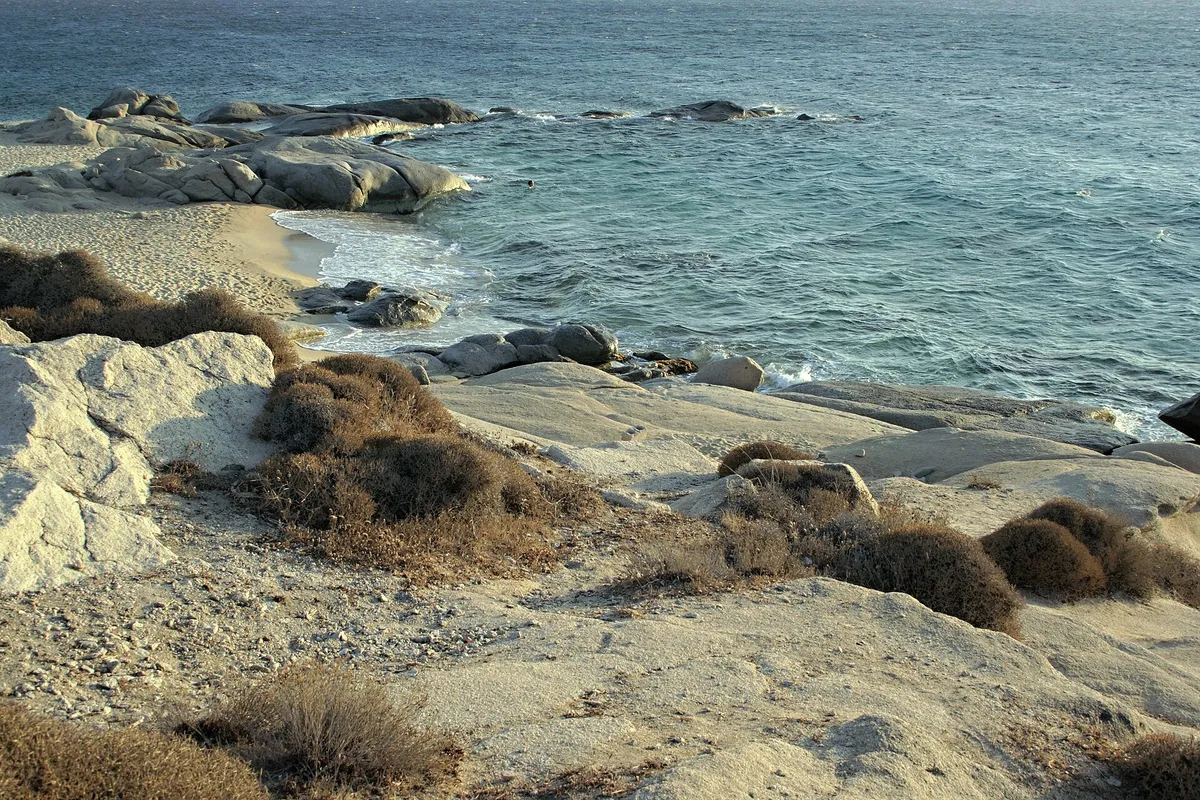
October's soft light on the granite shoreline at Agia Anna - the shoulder month's calmer, emptier water. Photo: Wikimedia Commons (CC BY-SA), attribution in caption.
Winter: What Actually Runs
December through March, Naxos stays a living island - year-round residents, open tavernas in town, the Kastro's winter light - but the boat day effectively pauses:
The fleet lays up. The compared boats haul or moor for the season; the organised day-trip trade stops with the weather calendars. A hardy skipper will negotiate a private winter run on a calm week for a price that reflects the hour, but nobody should plan a winter trip around it.
The ferries carry on. The scheduled lines to Piraeus and the inner Cyclades run winter timetables - island-hopping by ferry remains fully possible, and the Portara has never been more atmospheric than over a January sea.
The substitute days: the villages, the Mount Zas trails, the quarries' Kouroi, and long lunches that make the boat week's absence feel like a different, still-good island.
Plan winter trips as land holidays with ferry options; plan the boat days for the season that earns them.
Booking Patterns That Beat the Wind
The patterns reviewers and repeaters converge on, distilled:
Book early-week, early-day. A Monday-Tuesday morning slot gives a wind day room to re-book into; the same ticket on your last Friday has nowhere to go.
Hold two, keep one. The pay-later terms mean a seat costs nothing until you stop being able to cancel. Holding the flagship and the cave trip for different days, then releasing one inside 24 hours, is the local pattern for a reason.
Watch the forecast at 48 hours, not 48 minutes. The meltemi publishes its plans honestly; a Force 6 flag on Tuesday's forecast moves Sunday's booking for free.
Match boat to month, not month to boat. Windy-week bookings belong to the stable hulls (the catamarans, the wooden heavyweight); calm-week bookings can chase the boutique seats (the nine-guest Jeanneau). The Naxos boat tours price table is the menu.
The buffer rule: one spare afternoon per three boat-dependent days. The meltemi does not always use it, and the trip where it does not is the one people remember as perfect.
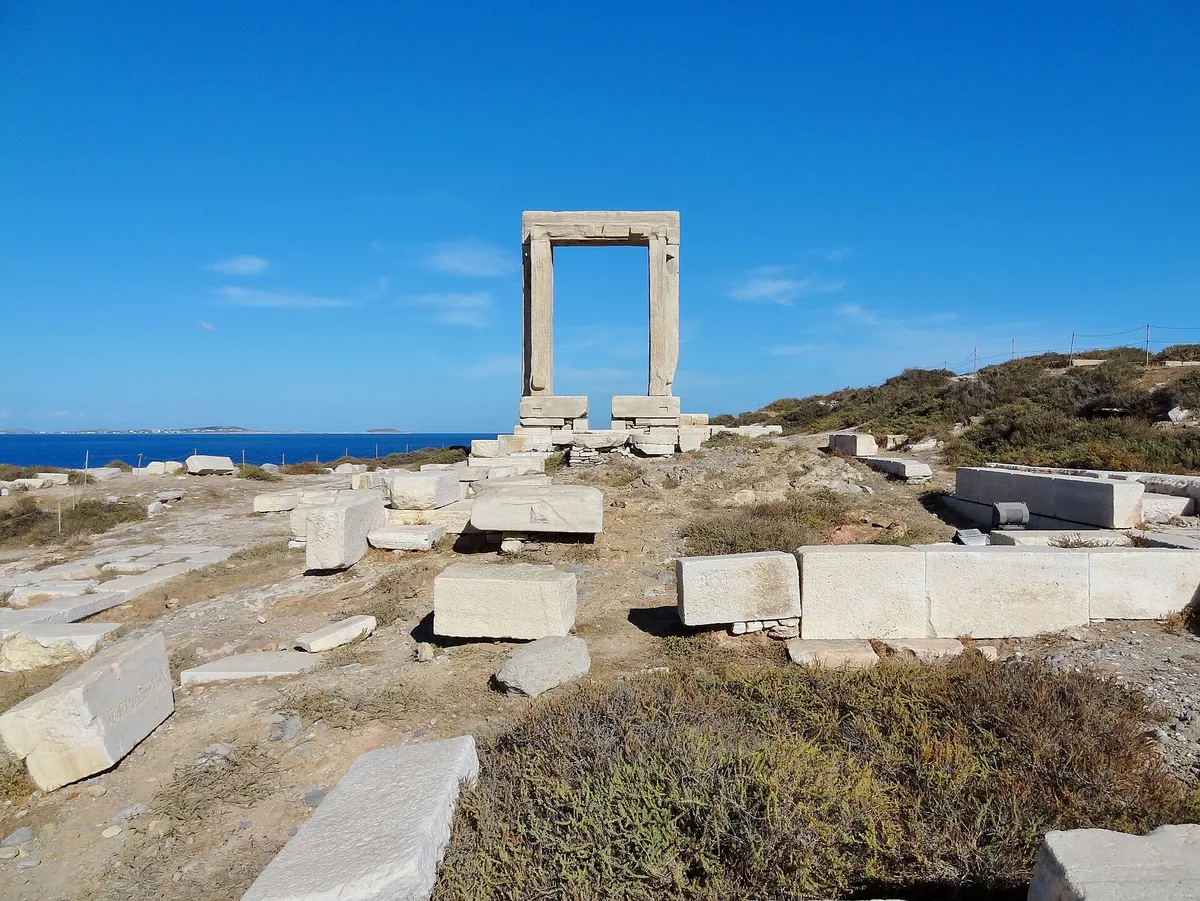
The Portara from its mound - the evening slot's payoff, and the reason the sunset sail exists. Photo: Wikimedia Commons (CC BY-SA), attribution in caption.
Reading the Forecast Like a Captain
The apps are free and the skill is learnable; captains read three layers in this order:
Wind direction first, strength second. A northerly at Force 5 is a route-swap; a southerly at Force 5 is an event. Naxos's boats plan against the meltemi's northerly regime - direction tells you which coast is leeward before any number does.
Swell, not just wind. The cave's inside swim and the exposed anchorages answer to swell - a leftover sea running after the wind has eased fools the apps and the swimmers alike. 'Wind 8 knots, swell 1.4 metres' is a no-cave day.
The hourly build. The daily curve matters more than the daily maximum: 8 knots at 09:00 building to 18 by 15:00 is a normal July day; the same numbers reversed make an afternoon miracle. The forecast's graph is the booking tool; the headline number is marketing.
Then the local layer: the island's fishermen, the crews' own morning messages, and the harbour's flag. The platforms' cancellation messages are the last word - they arrive the evening before, and they are honest.
Wind Days: What Still Works When the Boats Bend
A meltemi day is not a lost day on the water; it is a different menu:
The leeward runs still go. The south-coast coves and the Panermos cave country sit behind the island's shoulder - on Force 5-6 days the two-hour trips are often the only tickets running, and they run pleasantly.
The big stable hulls hold their comfort. The catamarans' beam and the wooden heavyweight's mass keep their decks pleasant in seas that end a rigid-inflatable's morning; windy-week bookings should weight toward them. The Naxos boat tours compared side by side sorts by hull.
The sunset slot's sheltered arithmetic. The evening sail picks its anchorage for the day's actual wind - a shorter, closer, calmer version of the afternoon's open water.
And the honest floor: every route has a wind day where the right answer is the beach on the leeward side and a taverna that knows your order. The boats will run again; the cancellation windows make sure you do not pay for the lesson.
The Season on a Plate: Three Sample Weeks
The June week (the connoisseur's): boat day one - the flagship on a flat sea; a rental-car south-coast day with the cave trip on day three; the sunset sail mid-week; beaches and villages filling the rest. Re-book nothing; the meltemi is still waking up.
The August week (the realist's): book every boat for morning slots before leaving home; hold the catamaran as the wind-day swap for the wooden boats; treat one afternoon forecast as a beach mandate. The week that accepts the wind gets all its boats in.
The late-September week (the sleeper's): the warmest water of the year, the fleet still full-time, the islands quiet again. Two boat days back-to-back are actually advisable here - the sea is at its kindest - and the Jeanneau's nine seats bookable a week out is the season's quiet luxury.
The pattern underneath all three: match the boat density to the wind confidence, and let the free-cancellation windows do the negotiations with the sky.
Matching the Boat to the Month
The boats differ in what they ask of the weather; the month-by-month verdict from Naxos boat tours - the listings compared here:
Flat-water months (May-Jun, mid-Sep-Oct): everything runs; the choice is taste. The nine-guest Jeanneau and the sunset sail are at their purest - light-wind boats that reward calm.
The meltemi months (Jul-Aug): weight toward stability and short formats. The catamarans' beam, the wooden heavyweight's mass and the two-hour cave trip's window-flexibility are the honest picks; the sunset sail's sheltered anchorage formula keeps it running when full-day routes bend.
The shoulder edges (Apr, late Oct): schedules thin and the sea cools from both ends of the month; the full-day boats with cooked meals earn their fare as the water hours shorten around them.
Winter: the fleet lays up; the ferries and the Portara carry the water-borne romance alone.
The meta-rule the mapping encodes: book the hull that suits the month's wind, not the month that suits the hull - and let the free-cancellation windows arbitrate the edge cases.
Sea Temperature and the Swimming Calendar
Air temperatures sell the season; sea temperatures decide the swims. The Aegean around Naxos runs its own delayed calendar:
May: the sea is at its clearest and coldest - 18-19°C, brisk, blue, and swimmable for the willing rather than the cautious. The season's snorkel visibility is at its peak.
June: 22°C and rising - the month the water stops being an achievement. The full-day swim schedules feel effortless.
July-August: 24-25°C, bathwater by Aegean standards; the swims lengthen, the decks empty at every stop, and the only thermal event is the meltemi's wind-chill on the ride home - the dry layer again.
September: the year's warmest water, 24-25°C held from the summer's storage, with air temperatures that make the contrast perfect. The connoisseur's swimming month, and the reason September boat reviews read like adverts.
October: 21-22°C - warmer than June, calmer than August, emptier than both. The season's last honest swim month; the fleet runs until the wind ends it.
The booking takeaway: swimmers who measure holidays in water hours should weight the year's second half; the sea remembers the summer longer than the air does.
The Noon Question: Why Midday Is the Fleet's Favourite Hour
Between the flat morning and the windy return sits the stretch that decides how a boat day photographs: the anchorage hours.
The logic is nautical before it is culinary. The meltemi's build makes open-water legs unpleasant by early afternoon, so the fleet schedules its stops to put the day's exposed kilometres in the morning and its stationary hours - lunch, the long swim, the siesta - at the day's windiest. The anchorage is chosen for holding quality: sand over weed, shelter from the north, and a swim line the crew can watch.
For passengers this is the day's deep middle: the second swim (or the fifth), the on-board meal, the sunbathers' hour and the children's second wind. Reviews that praise a boat's pace are usually praising this block - the difference between a timetable and a day.
For the wind-averse it is also the mercy: the hour you feel the swell least is the hour you are not moving. Sea-sickness-prone travellers should eat light at lunch, sit in the shade, and re-board for the home leg with the tablet already taken.
And for photographers: noon is the wrong hour for landscapes and the right one for water colour - the shallows over sand photograph best with the sun high, which is why every Koufonisia shot looks like that.
Questions About Timing
Which month is the best to visit Naxos?
For boat-centred trips, late May-June and September: warm water, gentlest wind, full schedules without peak-week pressure. For beach-plus-boat holidays that do not mind company, July-August work with the morning-departure rule. The island's land pleasures run May through October almost unchanged.
How many days in Naxos is enough?
How many days in Naxos is enough? Three to five, is the honest count: one or two boat days, one full beach day on the west-coast sand line, and a villages-and-Mount-Zas day in between. Two days works if the boat day is booked for day one - it is the first thing to sell out and the hardest to move when the wind intervenes.
Which is nicer, Paros or Naxos?
Naxos for scale - the beaches, the mountain, the working island feel - and Paros for polish and compactness. The catamaran that crosses to Paros-side water on windy days is one honest way to sample both in a week. Boaters' note: Naxos's fleet is the larger of the two.
What are the best months to sail in Greece?
May-June and September-October nationally - the same windows Naxos runs - with the Aegean's meltemi making July-August the strong-wind season that sailing-first travellers either train for or avoid. The Cyclades sit at the meltemi's core; the Ionian is the calmer-summer alternative.
What is the windiest month in the Cyclades?
July and August, when the meltemi runs at full strength - steady Force 4-6 with stronger spells. The wind is the season's rhythm rather than its exception: morning departures ride the calm half of every day, and the month-by-month table shows how the verdicts shift around it.
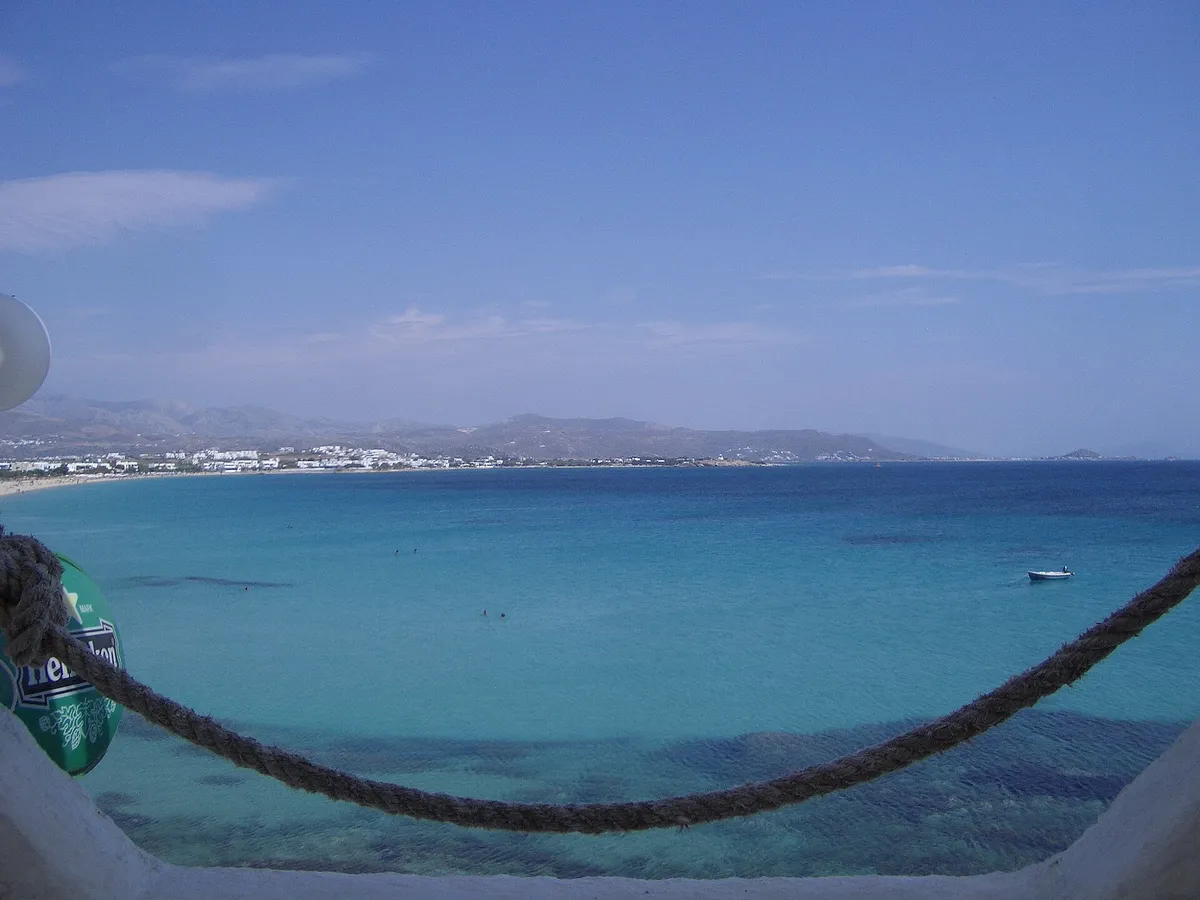
A west-coast bay from a beach terrace - the calm-water view that fills May, June and September mornings. Photo: Wikimedia Commons (CC BY-SA), attribution in caption.