 Naxos Boat Tours
The Koufonisia Day Trip from Naxos, Done Properly
The Koufonisia day trip from Naxos is the excursion most visitors book first, and the one most worth second-guessing: several boats run versions of it, the little Skopelitis ferry runs it as plain transport, and the island itself rewards exactly one kind of afternoon. This guide compares the ways, times the crossings, and plans the hours - with every boat option priced in the Naxos boat tours roundup.
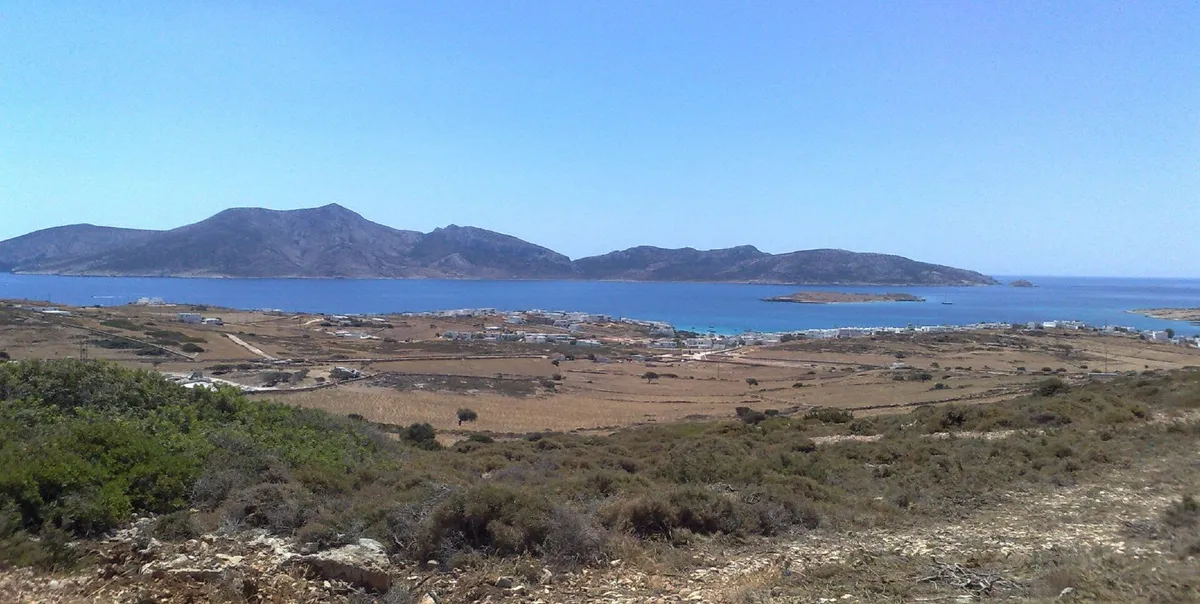
The view from Ano Koufonisi toward Keros - the island hour every boat day is built around. Photo: Wikimedia Commons (CC BY), attribution in caption.
Quick answer Yes - and the choice is a cruise with stops or the slow ferry; here is which traveller wins which way
Yes, Koufonisia is a straightforward day trip from Naxos: the organised boats cross in about 1.5-2.5 hours with swim stops built in, and the small Skopelitis ferry runs the line as scheduled transport in roughly two hours. The organised Koufonisia + Rina Cave cruise - from $104, 9.5 hours, 4.8★ across 795 reviews - is the default: islands, cave, lunch, no logistics. The ferry wins for slow-travel types who want the island's cafe life without a timetable. What the day needs either way: an early start, cash, a wind-flexible plan, and the acceptance that Ano Koufonissi is about beaches and water colour, not sights.
Key takeaways
- Default choice: the cruise with the cave stop - three stops, BBQ, 24-hour free cancellation.
- Ferry choice: the Skopelitis for independence - but no cave stop, no lunch, and a firm return timetable.
- Book for early in your week - wind moves these days, and every listing's free-cancellation window is the tool.
Can You Do a Day Trip to Koufonisia? Yes - Here Is the Shape
The Koufonisia sit about 18 nautical miles south-east of Naxos - two inhabited-adjacent islands (Ano and Kato Koufonissi) in the Small Cyclades chain, close enough that the boats treating them as a day target never feel like a stunt. The answer to the feasibility question is an unqualified yes, with three working models:
The organised cruise - most of the island's visitors' choice, and the shape this site's Naxos boat tours compares: out of Agia Anna in the morning, two or three swim stops across the Koufonisia water and the Rina cave, a meal on board, back by early evening. From $74 to $162 depending on the boat, checked September 2026.
The scheduled ferry - the small Skopelitis-line vessel that serves the Small Cyclades as a bus route with a rail behind it. Slower, cheaper, no swimming stops: you ride, you land, you island on your own clock, you ride back on its clock.
The hybrid - cruise out for the stops, and (on days the schedules align) ferry variants - more planning than reward for most first-timers, but the slow-travel crowd swears by the return leg at sunset.
What the day is not: a sightseeing trip. Ano Koufonissi's "sights" are a harbour, a chora of whitewash lanes, and some of the Cyclades' most swimmable water. The beach-and-water day is the product; everything on this page serves it.
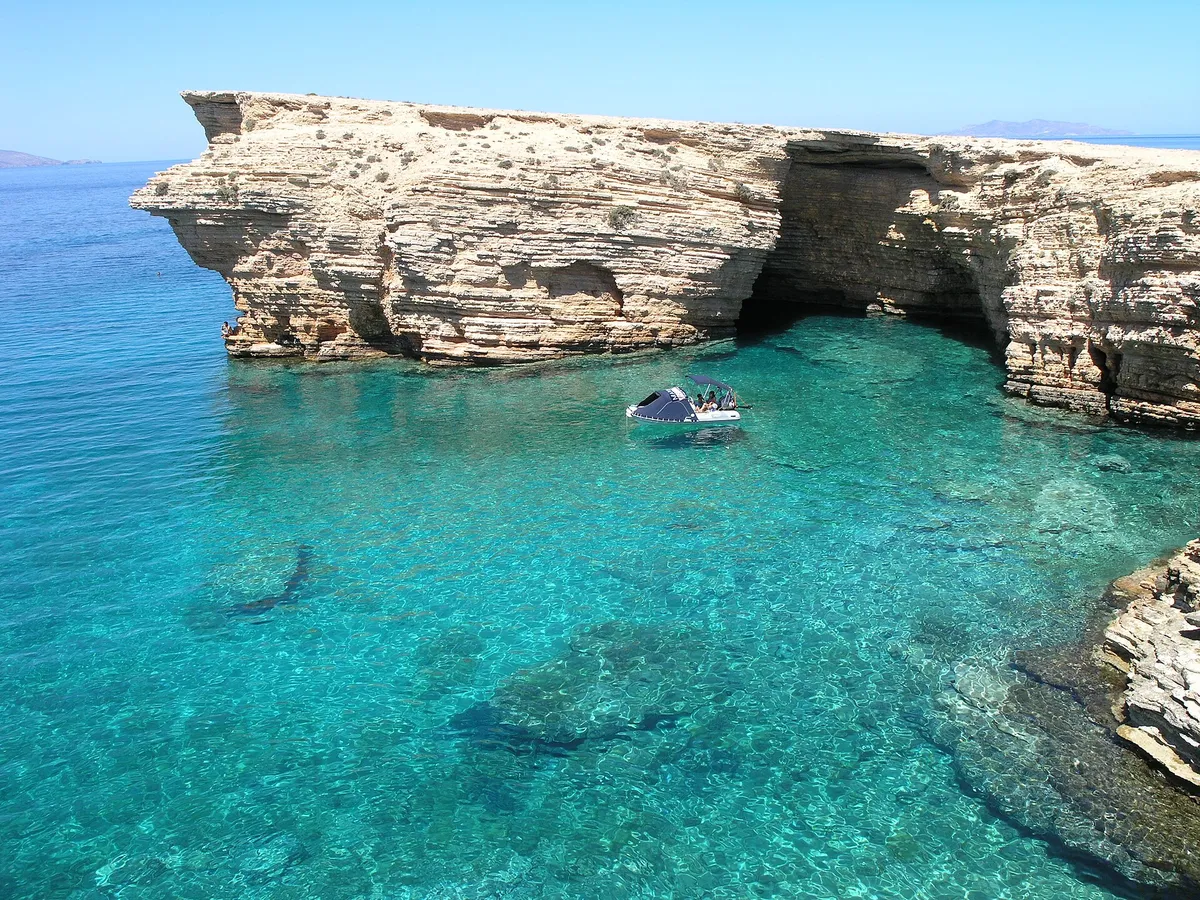
The Koufonisia water the day is built around: golden rock, sea arches and a boat at anchor. Photo: Wikimedia Commons (CC BY), attribution in caption.
The Organised Boats, Compared
The organised Naxos boat tours in this catalog run Koufonisia routes, and they split by philosophy:
The wooden classic - the Rina Cave & Koufonisia cruise on the IASON from Agia Anna: the 795-review benchmark, BBQ with local wine, three stops including the cave. The one to book when the day should feel like a Greek island film.
The modern island day - the Jason Daily Cruise boat: same from-price, unlimited soft drinks, the island cafe hour built in, rock-climbing optional. The family-tempo alternative.
The sailing boutique - the Jeanneau yacht day: nine guests, 16-plus, freshly cooked lunch, coves before crowds. The premium answer to the same water.
The differences that matter at booking: boat culture (wooden ritual vs modern comfort vs yacht), the cave (first two include it, the yacht's route bends toward it), and the crowd (795 reviews of company vs nine seats of quiet). All three share the honest variables - wind-shaped stop order, 24-hour free cancellation, morning-departure logic.
| Way | Crossing | What the fare includes | Best for |
|---|---|---|---|
| Wooden BBQ cruise | ~1.5-2 h + island legs | Three stops incl. Rina Cave, BBQ lunch, local wine, gear | The classic island day |
| Jason Daily Cruise day | ~1.5-2 h + island legs | Cave + island stops, BBQ, unlimited soft drinks, cafe hour | Families and slow hours |
| Nine-guest Jeanneau | Sailing legs, wind-set | Cove swimming, cooked lunch, max 9 guests, 16+ | Adults who hate crowds |
The Skopelitis Ferry Alternative
The express Skopelitis (operated on the Naxos-Amorgos line with Small Cyclades calls) is the islands' lifeline and the independent traveller's tool. The facts a day-tripper needs:
The crossing runs roughly two hours from Naxos to Ano Koufonissi, with the boat continuing on to Iraklia, Schinoussa and Amorgos - it is a working route, not an excursion, and it loads at the main port rather than Agia Anna.
The timetable is seasonal and firm. In summer the connections allow a long day on the island with a late-afternoon return; shoulder weeks thin the schedule to the point where the day shrinks. Check current times the week you travel - ferry schedules are published seasonally and shift.
The trade, stated plainly: the ferry costs a fraction of a cruise seat and buys total independence - no megaphone, no lunch queue, your own hours. It does not stop at the Rina cave, does not feed you, and its upper deck in a meltemi is a wind tunnel. Day-trippers who choose it should book nothing else for that day and let the island set the pace; the beach bags and cafe receipts are the fare's real return.
One warning from the island's rhythm: the Koufonisia's population tripled on the water is still small - the ferry's arrival reorganises the harbour's lunch tables. Either embrace the first-ferry wave or wait it out with the second coffee.
Ano Koufonissi on Foot: What Three Hours Buys
Ano Koufonissi - the inhabited twin, "Pano" in the older names - is small enough that three hours cover its essentials with time left for doing nothing, which is the point. The working plan from the harbour:
First 20 minutes: the harbour and chora. Fishing boats, the small fleet of excursion craft, a whitewash village of lanes built for walking nowhere in particular. Cash point exists; queues at noon do too.
The harbour-to-Pori walk - 25-35 minutes along the island's east coast, past the campsite bay and the seafood taverna famous far beyond the island's size, to Pori beach: the island's big sand-and-turquoise payoff, with a beach bar in season and enough space that the day boats' crowds thin to texture.
The swim, which is the reason anyone came: shallow, glass-clear, sand-underfoot water that photographs like an edit and is not.
The return leg on foot or - the island's one concession to urgency - the little bus service that runs harbour-to-Pori when demand asks. Water shoes for the rocky edges, cash for everything, and the ferry/cruise clock checked once, mid-afternoon, to keep the ending boring.
Kato Koufonissi, the southern twin, is the boats' picnic island - a chapel, beaches, no settlement - which is why it appears as a swim stop rather than a stroll: organised days include it from the water, ferry days mostly skip it.
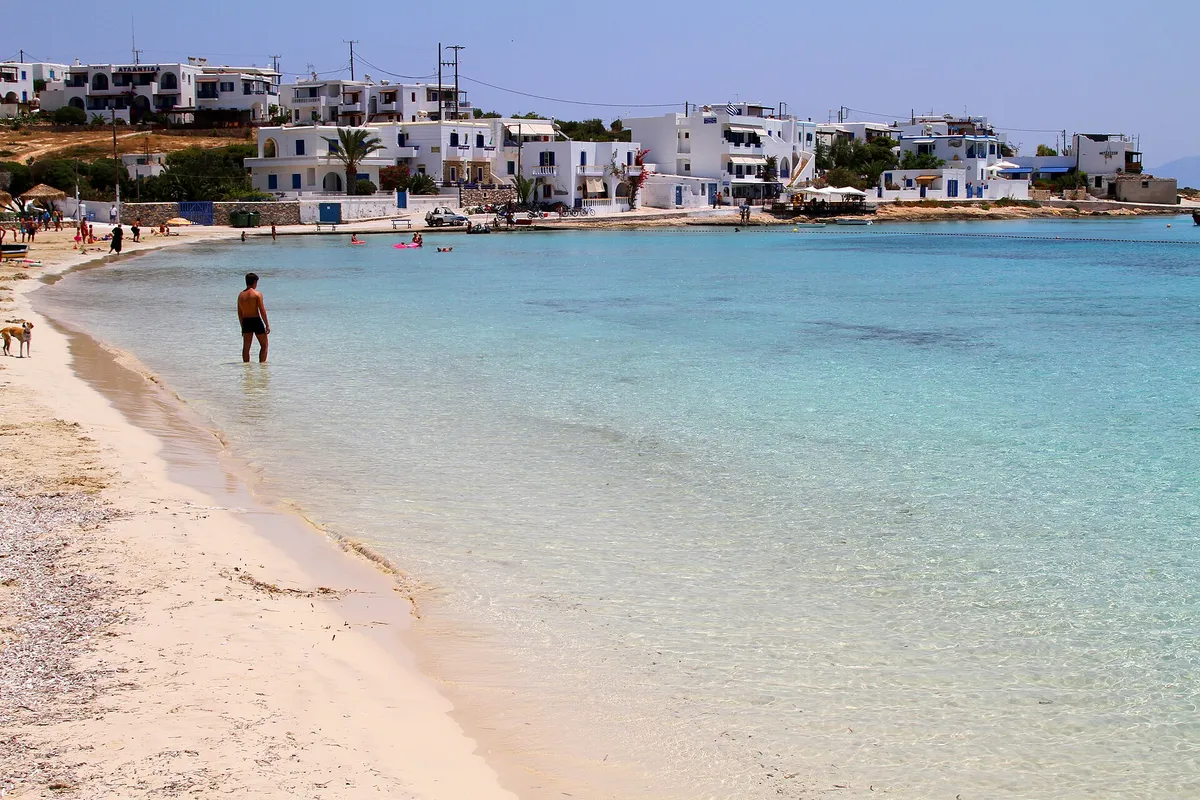
Ano Koufonissi's harbour beach - the day's first walk, from the quay into the whitewash lanes. Photo: Wikimedia Commons (CC BY-SA), attribution in caption.
Best Time of Year and Day for the Crossing
The Koufonisia crossing runs against the summer's prevailing north wind, which makes timing the day's most leveraged decision:
Season: May-June and September-October give the calmest seas and the islands without their August crowd-density; July-August run the full schedule with the meltemi at its peak - swimmable, but livelier water and fuller boats. The month-by-month detail lives in the best-time guide.
Time of day: morning departures win on every axis - the wind builds through the afternoon, so the outbound morning crossing rides flattest, and the islands are calmest before the fleet lands its lunch waves. Afternoon-return legs run the chop; sit aft, or sleep through it like the locals.
Day of week: no ferry logic here, but the excursion fleet's pressure peaks mid-week in August - Sunday-to-Tuesday boats run roomier in the peak weeks.
The booking pattern that wins: hold a cruise seat (pay-later, free cancellation) for your first or second morning, watch the forecast two days out, and re-book inside 24 hours if the meltemi publishes a bad plan. Ferry tickets are the fallback that never sells out.
What a Koufonisia Day Costs
The price ladder, read September 2026 and converted to dollars at the month's rate:
- Organised cruise seats: from $74 (Schinoussa-Iraklia sailing - the alternative chain), $104 for both Koufonisia boats, $162 for the nine-guest yacht. All include their stated meals and stops; all cancel free to 24 hours. - The ferry prices as transport - single-digit-to-low-tens of euros each way in season, a fraction of any cruise seat. - On-island costs: cafe and taverna prices run slightly under Naxos town's tourist strip; the Pori beach bar charges beach-bar prices; the island bus is a few euros. - The hidden cost either way: the morning. Agia Anna boats start at 08:30, the ferry earlier still - the day's real currency is the alarm.
Where the money buys most: the cruise seat for first-timers (the cave and the meal are real value at $104); the ferry for second-visitors who want the island without the program. Mixing - cruise out one visit, ferry the next - is the local recommendation and the reason this page exists.
Common Mistakes on the Koufonisia Day
Booking it for the last day of the trip. The wind-cancel-and-move pattern needs runway; day-one or day-two bookings use the 24-hour window as designed and re-book rather than mourn.
Expecting sights. The island's product is water, sand and taverna tables. Travellers who need ruins should point the day at Delos instead - different island, different century.
Bringing the wrong shoes. The harbour-to-Pori walk is a path, not a promenade; flip-flops do it, barely, and regret it. Water shoes double for the rocky swim edges.
Underestimating the sun on water. The crossing's two hours are open-deck; the Aegean burns through what feels like cloudless kindness. The packing list exists because of this paragraph.
Leaving the cash behind. Koufonisia's tavernas and taxis remain card-shy by temperament; the harbour ATM queue at 12:30 is a real thing.
Skipping the cave question. If the Rina cave is the day's must, book a boat that includes it - the ferry does not, and not all routes do on windy days. Ask the listing, not the hope.
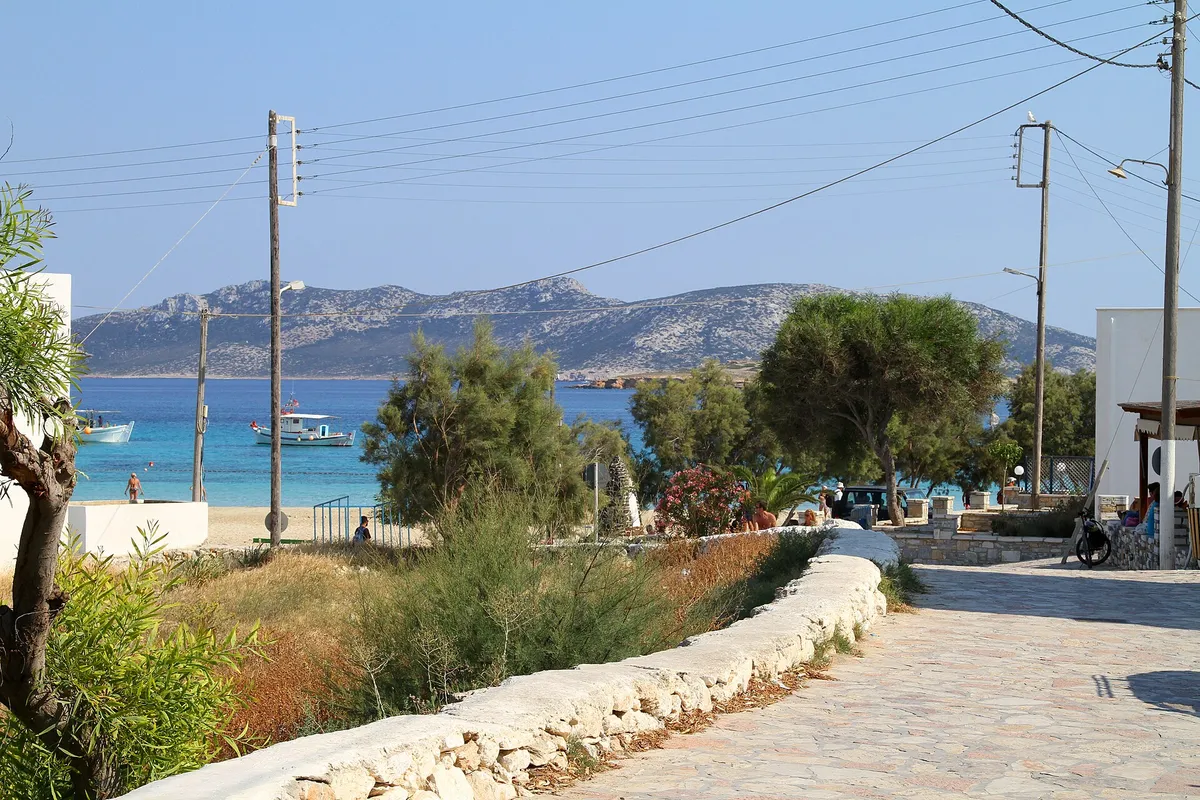
The island's tempo: a village path, a low wall, and the bay doing its colour work in the background. Photo: Wikimedia Commons (CC BY-SA), attribution in caption.
Reading the Koufonisia Listings Like an Editor
The Koufonisia listings share a route and compete on details; here is the checklist this catalog reads before any boat earns a card:
The stops, named. Listings that name Kato Koufonissi, the Rina cave and the cafe hour are promising a route; listings that promise 'swimming and beautiful bays' are promising a mood. Both can be good days - only one can be planned around.
The meal clause. BBQ versus lunch versus none is the biggest per-euro variable on the route: the wooden boats cook meat with wine, the modern boats add unlimited soft drinks, the yacht cooks fresh for nine. Read what is included, then price the taverna alternative yourself.
The silence pattern. Group size, age limits, access - unstated fields are the operator declining to promise. The reviews supply the missing shapes: this page's boat comparisons carry the honest versions.
The review base's shape. 795 reviews at 4.8 and 130 at 4.7 are different kinds of evidence: one is a statistics, the other is a set of stories. Both belong in the decision; neither replaces the weather.
And the meta-rule: any listing that answers a message in writing within a day is telling you how the day itself will run.
The Crossing, Hour by Hour: What the Water Does
The Naxos-Koufonisia water has a daily personality, and the crossing hours decide how the day feels before anyone swims:
Departure hour, flat water. The morning boats leave on the overnight calm - the strait between Naxos and the islands reads as a lake with opinions. Coffee on deck, islands arriving slowly; the crossing most travellers imagine.
Mid-morning, the breeze arrives. The meltemi's daily build begins late morning; whitecaps appear on the exposed legs first. Boats are typically at anchor for the lunch hours - the schedule puts the chop where the food is, which is thoughtful.
Afternoon, the working wind. The return legs ride the day's peak - 15-20 knots on a normal summer day, livelier in the meltemi's peak weeks. Sit aft where the pitch is kindest, take the tablet before boarding, and treat the spray as part of the ticket.
The evening exception: the ferries and the rare sunset runs use the wind's slow evening fall; the water softens before it darkens. Travellers who hate the chop but love the islands should look at the ferry's later returns - wind on a big steady boat is weather; wind on a small fast one is a ride.
A Koufonisia Day with Kids and Grandparents
The three-generation day is the Koufonisia's speciality, and the plan has three load-bearing choices:
The boat by boarding ease. Small harbour, quay-level boarding on the cruise fleet; the ferry's gangway handles strollers at the cost of a crowd. The family-focused boats - the BBQ day with its unlimited soft drinks, or the two-hour cave run's shorter arc - carry the review evidence for mixed ages.
The island hour by stamina. The harbour-to-Pori walk is 30 minutes each way on a path; grandparents ride the island bus, toddlers ride shoulders, and everyone meets at the same taverna. The beach itself is the leveller - shallow, glassy, and close to the coffee.
The timing by nap arithmetic. The morning boats land the islands at noon; the island's heat peaks at three; the return legs are nap-shaped for a reason. Build the day so the youngest swim happens before lunch and the return is sleep, not spectacle.
The honest constraint: the 9.5-hour cruise days are 6-plus comfortable, under-6s by stamina; the ferry day flexes to any pace because you set it. The full age-rules table carries the listing-by-listing detail.
Koufonisia in the Shoulder Months
The island's personality changes at each end of the season, and the day trip changes with it:
May: the water is clear and cool, the island empty enough that Pori beach reads like a private arrangement, and the boats run to demand - confirm the sailing the week you travel. The cafe hour happens in a fleece; the swim happens anyway.
June: the local's choice - everything running, nobody crowded, the meltemi still dozing. The reviews' favourite month for the crossing.
September: the sea at its warmest and the island winding down without closing; the harbour tavernas run their full menus and the light turns golden earlier each week.
October: the tail - boats on reduced weeks, the ferry's timetable thinning, and the day trip becoming a weather-lottery worth holding a ticket on. The island bus stops asking for fares around the same time the beach bars close.
The practical constant: cash, water shoes, and the packing list - the islands do not change their rules for the shoulder, only their crowds.
The Skopelitis Day, Hour by Hour
For travellers who take the ferry fork, the day's working timetable looks like this (schedules shift seasonally - confirm the week you travel):
07:30-08:00, the port. The ferry loads at the main harbour, not Agia Anna; tickets at the kiosk, coffee from the quay, seats claimed on the windward-or-leeward logic of the day.
08:00-10:00, the slow arc. The Small Cyclades line calls down the chain; the crossing to Koufonisia runs about two hours with the islands arriving at ferry pace - which is the point.
10:00-16:30, the island's own hours. Harbour coffee, the walk to Pori, the long swim, the taverna lunch that orders itself: no crew, no timetable, no megaphone. This is the ferry day's whole argument, and it is a good one.
16:30-18:30, the return arc. The boat collects the day-trippers down the chain and carries them home into the afternoon wind - the big hull keeps it honest.
The comparison in one line: the cruise day buys stops, meals and the cave; the ferry day buys the island entire. Travellers with two boat days in them should buy one of each - the Naxos boat tours catalog cruise page and this guide's ferry section between them cover both.
Questions About the Koufonisia Day Trip
Can you do a day trip to Koufonisia?
Yes - it is Naxos's most-booked excursion. Organised boats run it daily in season (from $104 with stops, lunch and the cave), and the Skopelitis ferry runs it as scheduled transport. The day works either way; the cruise adds the swimming stops, the ferry adds independence.
How long is the ferry from Naxos to Koufonisia?
About two hours on the Small Cyclades line. Organised boats cross faster in flat water (1.5-2 hours depending on the vessel) and slower against the wind - the afternoon return legs are the choppiest hour of the standard day.
Is Koufonisia worth visiting?
Yes - and it is the reason most people take a boat day at all: Pori beach's sand-and-turquoise shallows are the Cyclades' most swimmable postcard, and the island's scale makes the day effortless. Well worth visiting for the water and the pace; not the pick for ruins, shopping or shade-seekers - the trees are tamarisk and the sights are the sea.
What is the best day trip from Naxos?
For most visitors, this one: the Koufonisia boat day. For history-first travellers, the Delos and Mykonos day runs the same length with the ancient world instead of swimming; for the cave-curious on a budget, the two-hour Rina trip samples the signature stop without the day.
Can you swim at Koufonisia from the ferry day?
Yes - Pori and the harbour beaches are public swims; what the ferry skips is the boat-only stops: the Rina cave and Kato Koufonissi's coves. The ferry day trades the offshore highlights for the island's own hour, which many slow-travellers consider the fairer trade.
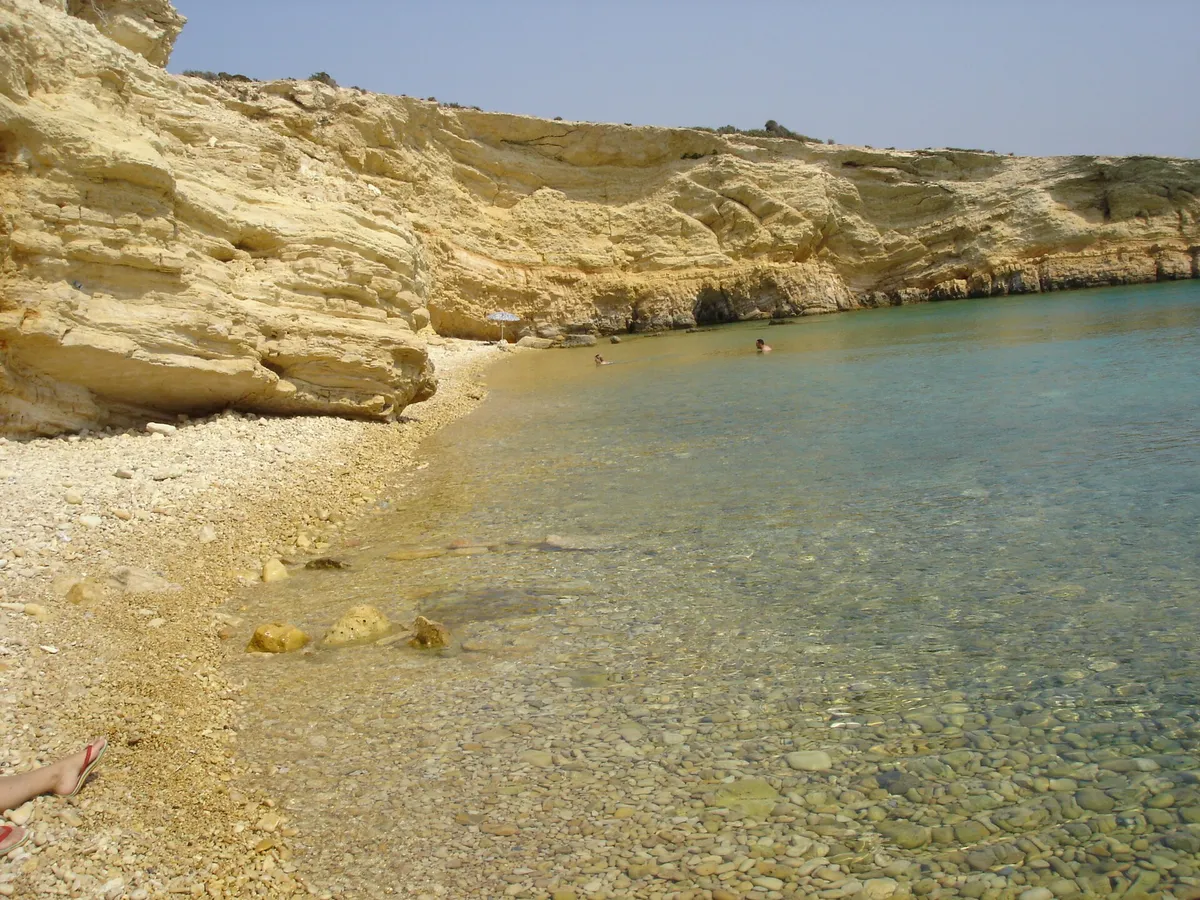
Kato Koufonissi's cove country - pebbles, golden rock and water like glass. Photo: Wikimedia Commons (public domain), attribution in caption.